

10 Key Injection Molding Parameters: How Temperature, Pressure, Speed & Time Affect Product Quality

Core Injection Molding Parameters and Product Quality
Injection molding is a complex process controlled jointly by temperature, pressure, speed, and time. From melting plastic pellets and conveying the melt to filling the mold cavity, holding pressure, and cooling, the process parameters at every stage affect the appearance, dimensional accuracy, internal structure, and production stability of the finished part. Properly setting and coordinating these parameters is key to improving injection-molded product quality, reducing defect rates, and boosting production efficiency.
I. 10 Core Parameters in Injection Molding
Injection molding parameters do not operate independently. Temperature determines the melt condition, pressure affects cavity filling and shrinkage compensation, speed controls the melt flow, and time influences the molding cycle and final part performance. The following 10 parameters are the key indicators that require close attention in injection molding production.
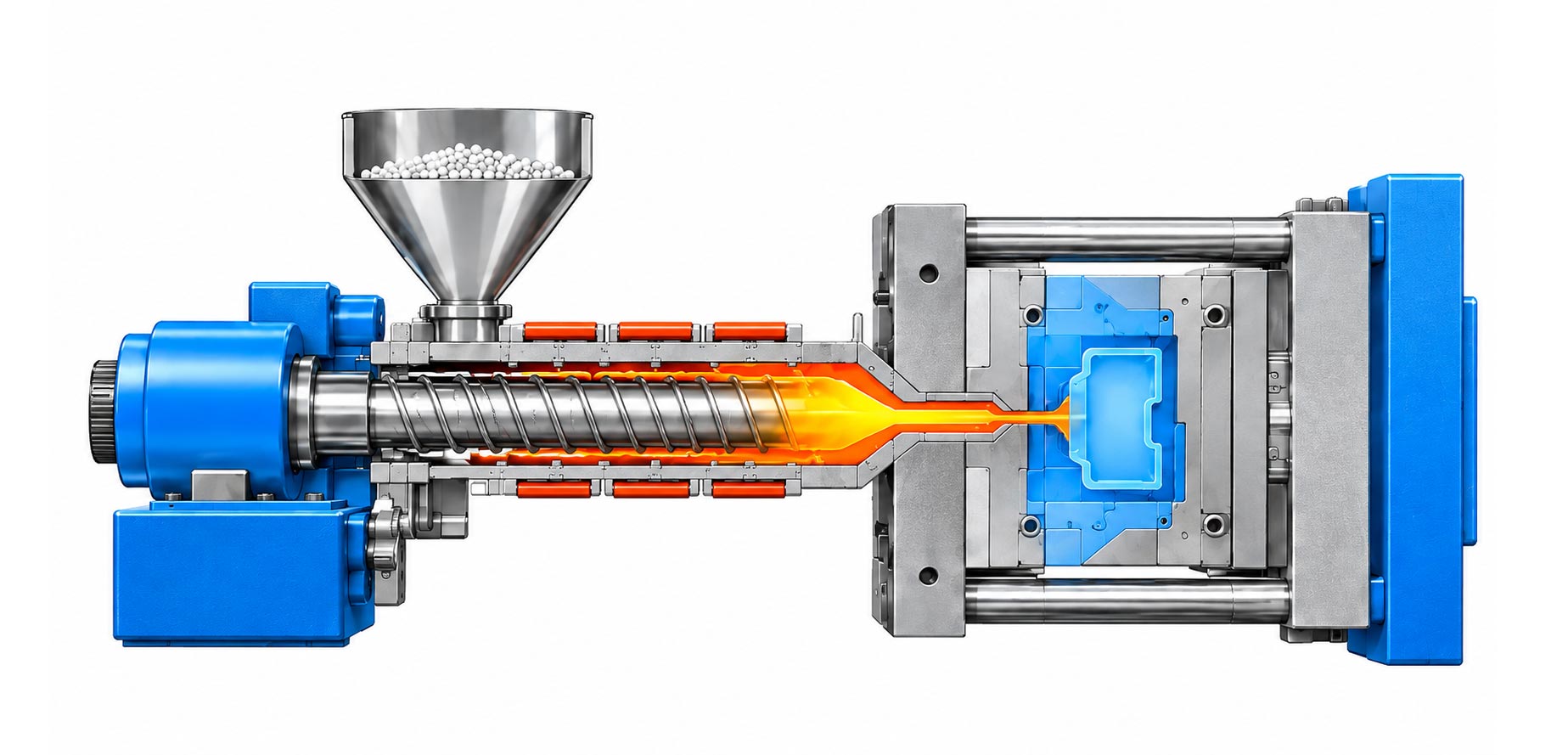
Melt temperature is the actual temperature reached after the plastic material is heated and plasticized. It directly affects melt flowability and plasticization condition.
Main effects: melt flowability, plasticization quality, part strength, surface gloss, and molding stability.
Mold temperature determines the cooling condition after the plastic melt enters the cavity, affecting crystallization, cooling rate, and demolding condition.
Main effects: surface quality, crystallinity, dimensional stability, warpage and deformation, and molding cycle.
Injection pressure drives the melt through the runner and gate into the mold cavity, ensuring the cavity is fully filled.
Main effects: cavity filling capability, part density, weld line quality, and molding defects such as flash and short shots.
Injection speed determines how fast the melt enters the cavity and affects the flow state and shear rate during filling.
Main effects: filling time, flow marks, weld lines, venting performance, and part surface appearance.
After the main cavity filling is completed, holding pressure continues to feed additional melt into the cavity to compensate for plastic shrinkage during cooling.
Main effects: part weight, dimensional accuracy, internal density, sink marks, and warpage and deformation.
Holding time is the duration over which holding pressure is maintained after injection is completed, and it is closely related to gate freeze-off time.
Main effects: part shrinkage rate, weight, dimensional stability, internal density, and molding cycle.
Cooling time is the time required for the plastic part to cool inside the mold and reach a condition suitable for demolding.
Main effects: part crystallinity, demolding strength, dimensional stability, warpage, and overall production cycle.
Back pressure is the opposing resistance encountered by the screw during retraction in the plasticizing stage, used to regulate melt compaction and mixing.
Main effects: plasticization uniformity, melt mixing quality, melt temperature, and color consistency of the part.
Screw speed determines the plasticizing and conveying speed of the plastic material under screw rotation, and is an important parameter affecting plasticization efficiency.
Main effects: plasticizing capacity, melt temperature, shear action, material mixing uniformity, and plasticizing time.
The cushion is the small amount of melt retained at the front of the screw after injection and holding are completed; it is also called the screw cushion pad.
Main effects: holding pressure stability, injection repeatability, part weight consistency, and production continuity.
II. The Relationship Between Temperature, Pressure, Speed, and Time
Injection molding is not simply a matter of adjusting a single parameter; it is a process in which multiple parameters work together. A change in one parameter often affects other process stages. Therefore, understanding the relationships between parameters matters more than merely memorizing their names.
01. Temperature and Melt Flowability
Raising melt temperature generally lowers the viscosity of the plastic melt, making it easier to flow; however, excessively high temperature may cause thermal degradation, discoloration, or gas generation. Mold temperature, on the other hand, affects melt cooling rate and the part's crystallization process. Both must be controlled appropriately in combination with material properties and part geometry.
02. Pressure and Part Density
Injection pressure is mainly used to overcome flow resistance and complete cavity filling, while holding pressure compensates for cooling shrinkage. Insufficient pressure may cause short shots, sink marks, or internal voids; excessive pressure may lead to flash, residual stress, and demolding difficulties.
03. Speed and Filling Quality
Injection speed directly affects the advancement of the melt front and the filling process. Too slow a speed may cause the melt to cool prematurely and fill inadequately; too fast a speed may increase the risk of shear heating, air traps, and jetting marks. In actual production, speed is usually adjusted according to part wall thickness, runner design, and material properties.
04. Time and Production Efficiency
Injection time, holding time, and cooling time jointly affect part molding quality and production cycle. Insufficient time settings may cause part shrinkage, deformation, or poor demolding; overly long settings may increase cycle costs. When optimizing, unnecessary waiting time should be reasonably shortened on the premise of stable part quality.
III. Common Injection Molding Defects and Parameter Adjustment Directions
In actual injection molding production, part defects are often caused by multiple factors together. The following summarizes several common defects and the parameter directions to check first, to help production personnel carry out preliminary analysis.
| Common Defect | Possible Causes | Priority Check Direction |
|---|---|---|
| Short shot, incomplete filling | Insufficient melt flowability, high filling resistance, or poor venting. | Melt temperature, injection speed, injection pressure, and mold venting. |
| Sink marks, depressions | Insufficient shrinkage compensation, locally thick wall sections, or uneven cooling. | Holding pressure, holding time, mold temperature, and cooling conditions. |
| Flash, burrs | Excessive cavity pressure, insufficient clamping force, or abnormal mold fit clearance. | Injection pressure, holding pressure, clamping force, and mold condition. |
| Warpage, deformation | Uneven cooling, differential shrinkage, or excessive residual stress. | Mold temperature, cooling time, holding parameters, and cooling system. |
| Prominent weld lines | Insufficient temperature when multiple melt fronts meet, or poor venting. | Melt temperature, mold temperature, injection speed, and venting conditions. |
| Silver streaks, splay marks on surface | Moisture in the material, volatile gases, or material thermal degradation. | Material drying, melt temperature, screw speed, and back pressure. |
| Weight variation | Unstable plasticization, inconsistent metering, or fluctuation during holding. | Screw speed, back pressure, cushion, and injection and holding parameters. |
Note: The above are preliminary troubleshooting directions for common defects, not fixed adjustment solutions. Actual process optimization must be comprehensively judged in combination with the plastic material, mold structure, part wall thickness, equipment performance, and on-site inspection results.
IV. How to Optimize Injection Molding Process Parameters
The goal of injection molding process optimization is not merely to run the equipment at a faster production speed, but to achieve stable, repeatable, and efficient production on the premise of ensuring part quality.
Based on the processing characteristics of different plastics such as PP, PE, PS, ABS, and PET, determine reasonable ranges for temperature, plasticization, and molding parameters.
Considering the number of cavities, gate location, runner design, part wall thickness, and cooling system, determine an appropriate filling and cooling plan.
Adjust injection speed, pressure, holding pressure, and cooling time according to the actual molding condition, and avoid over-adjusting a single parameter.
Track indicators such as injection profile, plasticization process, screw position, cushion, and part weight to detect process fluctuations in time.
Establish standardized process parameters and production records to reduce differences caused by manual adjustment and improve consistency across batches.
On the premise of ensuring part quality, equipment safety, and reliable demolding, optimize cooling, part take-out, and auxiliary action times to improve overall production efficiency.
V. The Relationship Between Injection Molding Automation and Process Stability
The quality of injection-molded parts depends not only on the injection molding machine and mold themselves, but also closely on part take-out, transfer, sorting, inspection, and downstream packaging. Especially in multi-cavity molds, high-speed injection, and continuous production scenarios, coordination of actions between equipment and matching of production cycle times are equally important.
Through injection molding robots, industrial robotic arms, and automated integrated systems, automatic part take-out, oriented placement, sorting, visual inspection, and downstream packaging can be realized, reducing the uncertainty introduced by manual operation and helping enterprises establish a more stable and continuous production flow.
SWITEK: Focused on Injection Molding Automation
SWITEK focuses on the field of injection molding automation, providing in-mold labeling (IML) systems, injection molding robots, industrial robotic arms, and injection molding automation system solutions, covering applications such as injection take-out, part sorting, inspection, packaging, and whole-line automation integration.
From single-machine automation to whole-line integration, SWITEK provides corresponding automation configuration solutions based on customers' product characteristics, injection molding equipment, mold structure, and production requirements, helping plastic products enterprises improve production efficiency, enhance part consistency, and reduce reliance on manual labor.
Summary: Let Every Process Parameter Play Its Proper Role
Melt temperature, mold temperature, injection pressure, injection speed, holding pressure, holding time, cooling time, back pressure, screw speed, and cushion together form the important process parameter system of injection molding. Only by understanding the function of each parameter and their interrelationships, and making scientific adjustments in combination with material, mold, and equipment conditions, can a reasonable balance be achieved among part quality, production efficiency, and manufacturing cost.
Understand the logic of temperature, flow, pressure, and cooling behind the parameters, and make injection molding production more stable and efficient.

More News
- < Previous : [Views]Choosing an IML Ma
- None : Next >

- Stock Code
838363

- +86 186 6517 1961
+86 186 6687 8722
-




- Chat
- Top