

IML vs IMD: 8 Key Practical Differences in In-Mold Decoration

Anyone working in injection molding or product appearance processes knows that IML (In-Mold Labeling) and IMD (In-Mold Decoration) are the two most commonly used — and most easily confused — processes in appearance injection molding.
Many beginners, and even some veteran technicians, tend to mix these two processes up. They may both seem like "in-mold decoration, integrated molding," but from product structure, mold design, and raw material selection to tuning parameters, production costs, and mass production stability, the two are worlds apart.
Once you make the wrong selection, adjust parameters haphazardly, or fail to design the mold correctly, you'll directly face a series of production problems: batch defects, film scratching and ink peeling, abnormal mold wear, and soaring production costs.
Today, no empty theory — we'll focus entirely on shop-floor practical experience, thoroughly breaking down the real differences between IML and IMD from 8 core dimensions, helping you select precisely and avoid all production pitfalls!
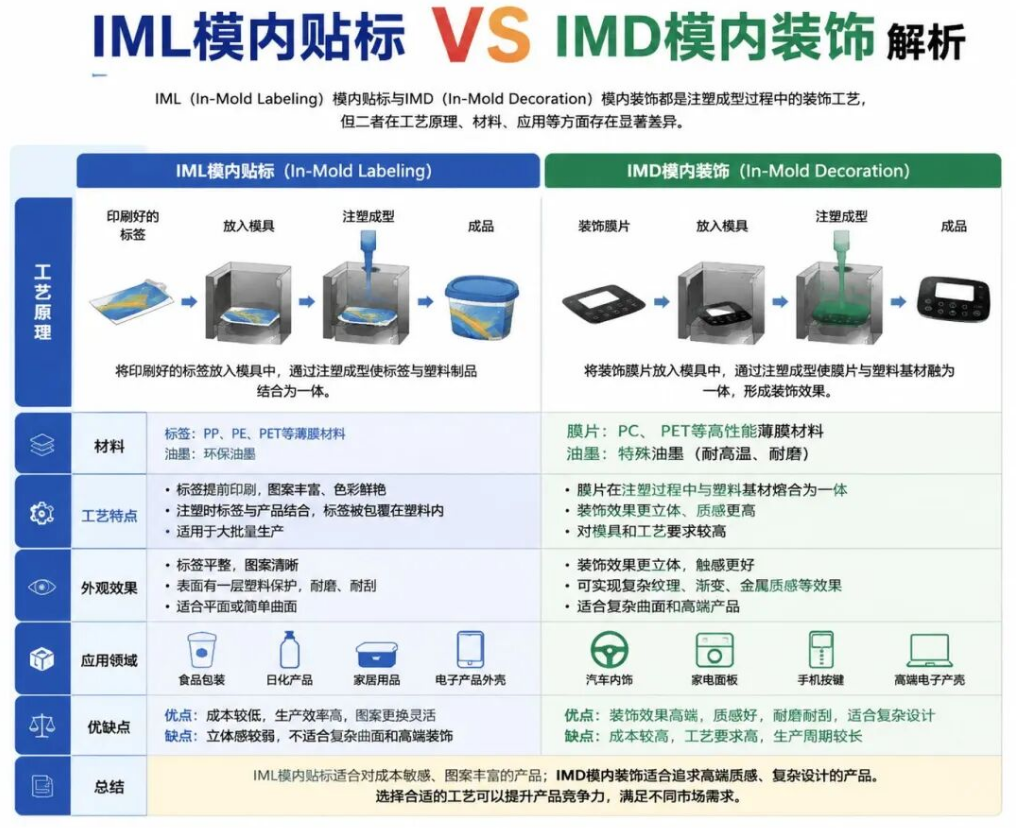
I. Understand the Core Principles First! Tell IML and IMD Apart at a Glance
This is the most essential difference between the two processes. Once you understand the principles, you've grasped half of the process logic.
IML In-Mold Labeling: Film Stays on the Product, Never Comes Off
Simply put: make the film first, place it in the mold, then integrate it in one shot. Patterns and textures are printed in advance and pre-formed into fixed-shape film sheets, which are placed into the mold cavity manually or by a robot. During injection, the high-temperature molten plastic fuses firmly with the film.
Core product feature: The film permanently remains on the product surface, and the ink layer is firmly sealed between the film and the plastic substrate — equivalent to adding a built-in protective shell to the appearance, so it will never peel or lose ink for its entire lifetime.
IMD In-Mold Decoration: Only the Pattern Transfers, the Film Carrier Is Taken Away
It can be understood as an in-mold transfer process, almost identical in principle to old-fashioned film projection, and is a fully automatic roll-to-roll continuous production mode. The equipment automatically feeds the entire roll of transfer film into the mold parting surface. Under the high temperature and pressure of injection, the ink and decorative layer on the film are directly transferred and adhered to the plastic part surface.
Core product feature: After molding and mold opening, the outer carrier film is automatically peeled off and taken away, leaving only the pattern coating on the final product — no整片 film.
II. Practical Comparison Across 8 Core Dimensions — Master Every Process Detail
Dimension 1: Product Structure Adaptability (Key to Avoiding Design Pitfalls)
IML In-Mold Labeling: Extremely high adaptability — the top choice for complex appearance products. It can handle deep cavity structures, large-stretch 3D curved surfaces, angular steps, and fully wrapped irregular products. Stretch depth has almost no strict limits, and film pre-forming alone can adapt to various complex shapes.
Draft angle ≥ 2° to prevent scratching the film or abrading the pattern during demolding; the parting line must avoid the film edges to eliminate mold-clamping film compression and pinching, preventing batch appearance defects.
IMD In-Mold Decoration: Extremely limited structure — only suitable for flat surfaces and gently curved shallow surfaces. Deep cavities, sharp corners, or large stretch ratio structures are absolutely forbidden, as they极易 cause pattern stretch deformation, ink deficiency, and film tearing.
The mold parting surface must be flat and smooth, free of burrs and sharp corners, to ensure stable roll film conveyance without scratching or tearing, guaranteeing continuous mass production stability.
Dimension 2: Raw Material Selection (Most Defects Stem from Material Mismatch)
IML Material System:
• Film: Mainstream PC, PET, PMMA, and composite films with a built-in hard coat layer, giving the finished product a scratch- and wear-resistant surface;
• Ink: Special high-temperature-resistant injection molding ink that must be pre-matched with both the film and plastic substrate to eliminate delamination and ink peeling;
• Substrate plastic: Commonly ABS, PC/ABS, PP — the core requirement is qualified compatibility to avoid blistering, delamination, and film detachment after injection.
IMD Material System:
• Film: Special multi-layer roll transfer film integrating hard coat layer, ink layer, adhesive layer, and release layer — with a fixed structure;
• Ink: Special high-temperature, high-pressure transfer ink ensuring complete release and firm adhesion during transfer, with no residual ink or ink loss;
• Substrate plastic: Mainly PC, ABS, PC/ABS — must match the transfer film adhesive system to prevent incomplete transfer and pattern脱落.
Dimension 3: Mold Design Key Points (If the Mold Is Wrong, Mass Production Will Fail)
IML Mold Core Design: Must be equipped with precise positioning structures to eliminate film displacement and misalignment, ensuring uniform position every shot; standard vacuum suction devices to make the film fully conform to the cavity, eliminating wrinkling, bulging, and悬空; gate position and injection method must be precisely designed to avoid direct frontal impact on the film, preventing the melt from washing out the pattern or scouring the ink; the parting surface must be treated to avoid the film, so mold clamping does not compress or damage the film edges.
Key Note: The film has a fixed thickness, which changes the plastic shrinkage rate and dimensions. Multi-cavity molds must ensure完全 consistent film positioning across all cavities; otherwise, uneven shrinkage across cavities will cause product dimensional deviations to exceed standards and batch scrappage.
IMD Mold Core Design: Standard roll film guiding, tensioning, and clamping mechanisms adapted to fully automatic feeders, precisely controlling the film feed step distance; parting surface sealing must meet standards to prevent injection leakage while avoiding pinching off the roll film; built-in vacuum suction structures to ensure the roll film lies flat against the mold with no pattern stretching or deformation; additional parting surface cleaning structures to promptly remove ink debris and adhesive屑, avoiding dirt-point defects; the entire cavity must be free of sharp edges and corners, protecting the roll film throughout and adapting to high-speed continuous production.
Dimension 4: Injection Molding Tuning Parameters (Veteran Operators' Core Experience)
IML Tuning Logic (Stable, Gentle, Uniform): Complete process: place film → close mold → inject → cool → open mold and eject. Injection speed and pressure should be moderate and on the gentle side — high-speed, high-pressure direct impact is strictly forbidden to prevent knocking the film askew or damaging the pattern; holding pressure and holding time should be stable and balanced to resolve plastic warpage, film layer wrinkling, and poor adhesion; sufficient cooling and setting to eliminate product internal stress and stabilize dimensional accuracy and appearance quality.
IMD Tuning Logic (Precise, Stable, Synchronized): Complete process: automatic film feed → vacuum film adhesion → close mold and transfer → injection molding → open mold and peel film. Temperature and pressure must strictly match the transfer film parameters to ensure complete ink transfer with no defects or exposed substrate; injection speed must be precisely controlled: too fast and the pattern blurs; too slow and cold slug marks and uneven transfer appear; mold opening and film peeling actions must be synchronized to avoid mold sticking or tearing the surface decorative layer; molding cycle must be constant, with precisely controlled film feed step distance, ensuring uniform pattern position for every shot and every cavity.
Dimension 5: Mass Production Control (Batch Production Efficiency Is Worlds Apart)
IML Production Characteristics (Flexibly Adapted to Small-to-Medium Batches): Production process: film printing → hot-press pre-forming → cutting → in-mold injection. Supports both manual loading and automatic robot loading modes, with convenient changeovers and adaptation to multi-category, small-batch orders. Control core: precise film positioning, no wrinkling, no ink washout, and smooth衔接 between all processes — then yield rate stays stable.
IMD Production Characteristics (Exclusively Adapted to Large-Batch Mass Production): Fully automatic roll-to-roll production throughout, with a simple process: roll film printing → automatic film-feed injection → automatic film peeling. No manual loading required, automation fully maxed out, production efficiency extremely high — but not suitable for frequent changeovers or small-batch production. Control core: stable film feed, complete transfer, clean peeling, and stable equipment with minimal downtime — then high output and high yield are achieved.
Dimension 6: Production Cost Analysis (Key to Saving Money Through Selection)
IML Cost (Low Entry Threshold, Flexible Batch Production): Low equipment modification threshold — no expensive dedicated feeder required, ordinary injection molding machines can be modified for production, small batches can start production, and upfront investment is controllable. For single-product large-batch production, film cost continues to be amortized downward, and yield rate depends entirely on process control and operational standardization.
IMD Cost (High Upfront, More Economical in Mass Production): Large upfront investment — requires custom dedicated molds plus fully automatic film-feeding equipment. Small-batch production has extremely low cost-effectiveness and is not worth the loss. However, the advantages of scaled large-batch production are obvious: full automation, extremely low labor costs, stable production, low defect rate, and per-unit comprehensive cost far superior to IML.
Dimension 7: Product Performance and Reliability
Both process finished products must undergo a full set of reliability tests: cross-cut adhesion test, thermal cycling, humidity resistance, UV aging resistance, alcohol and chemical corrosion resistance, RCA paper tape abrasion resistance, pencil hardness test, etc.
IML Performance: The ink is double-layer wrapped (plastic + protective film), isolating it from air, friction, and corrosion. Weather resistance, abrasion resistance, and service life far exceed IMD, making it suitable for long-term use products.
IMD Performance: The ink coating is directly exposed on the product surface. All abrasion, scratch, and aging resistance depend entirely on the quality of the surface coating, making it more prone to wear and paint loss with long-term use.
Dimension 8: Appearance Effect and Functional Implementation
IML Appearance & Function: Extremely high process inclusivity — can replicate wood grain, leather grain, brushed metal, matte frosted, soft-touch, and various other textures, while supporting backlight effects and hidden icon design. The surface film has built-in protective properties, is scratch-resistant and durable, and product durability is fully maxed out.
IMD Appearance & Function: Higher printing precision and极致 pattern fineness, with superior gradient, mirror, and ultra-fine texture effects. Focused on high-end flat decoration, adapted to functional appearance parts such as touch panels and smart sensor panels — balancing both aesthetic appeal and functionality.
III. Ultimate Selection Mnemonic! Never Choose the Wrong Process Again
After reviewing the 8-dimension comparison, simply memorize this set of practical selection principles and apply them directly in production and design:
✔ Choose IML: The product has deep cavities, irregular 3D curved surfaces, or complex structures; requires high durability and long service life; order batch sizes are flexible and frequent changeovers are needed;
✔ Choose IMD: The product has a flat or shallow curved structure; pursues极致 fine appearance; order volume is large with standardized mass production; requires high automation and low per-unit cost.
A final reminder to all injection molding colleagues: IML and IMD must absolutely never be used interchangeably! Product structure, mold, raw materials, and tuning parameters are all interlocked. Only by precisely matching the process can you stabilize yield, reduce waste, and control production costs.

- < Previous : [Tech]Injection Molding
- [Tech]Injection Molding : Next >

- Stock Code
838363

- +86 186 6517 1961
+86 186 6687 8722
-




- Chat
- Top