

Six Injection Molding Stages in 7 Diagrams

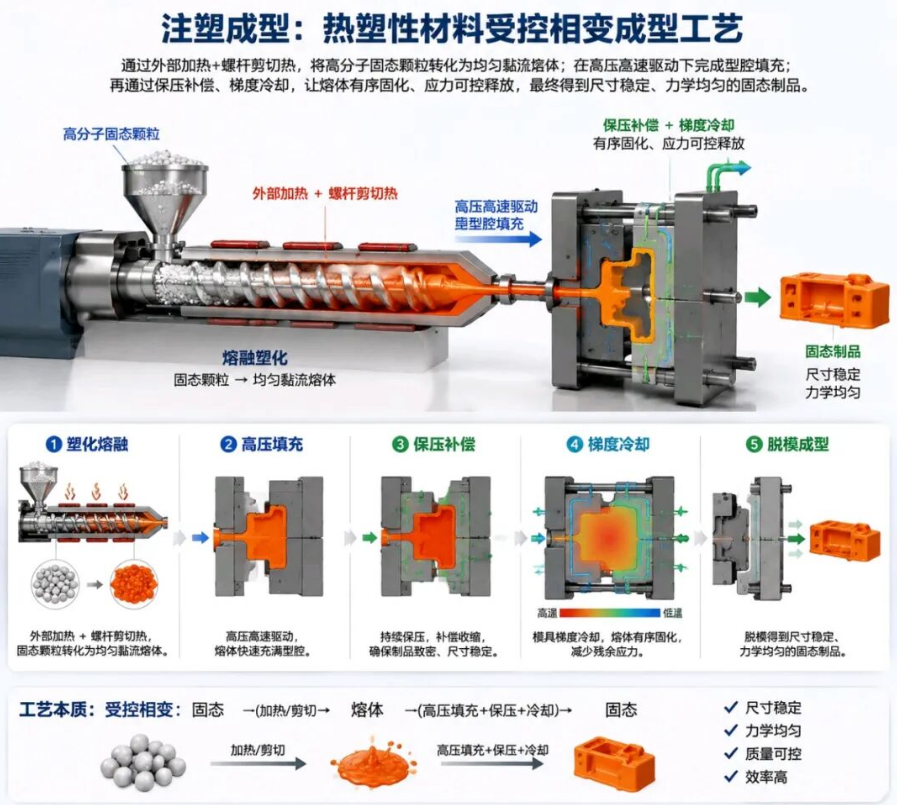
I. Injection Molding: Controlled Phase Transition of Thermoplastics
Injection molding is essentially a controlled "solid–melt–solid" phase transition process for thermoplastics. The entire workflow covers five core steps: plasticization and melting, high-pressure filling, holding pressure compensation, gradient cooling, and demolding. Through external heating and screw shearing, polymer pellets are transformed into a uniform melt, which is then driven by high pressure and high speed to fill the mold, followed by holding pressure for shrinkage compensation and gradient cooling, ultimately producing high-quality solid products with stable dimensions, uniform mechanical properties, and controllable quality.
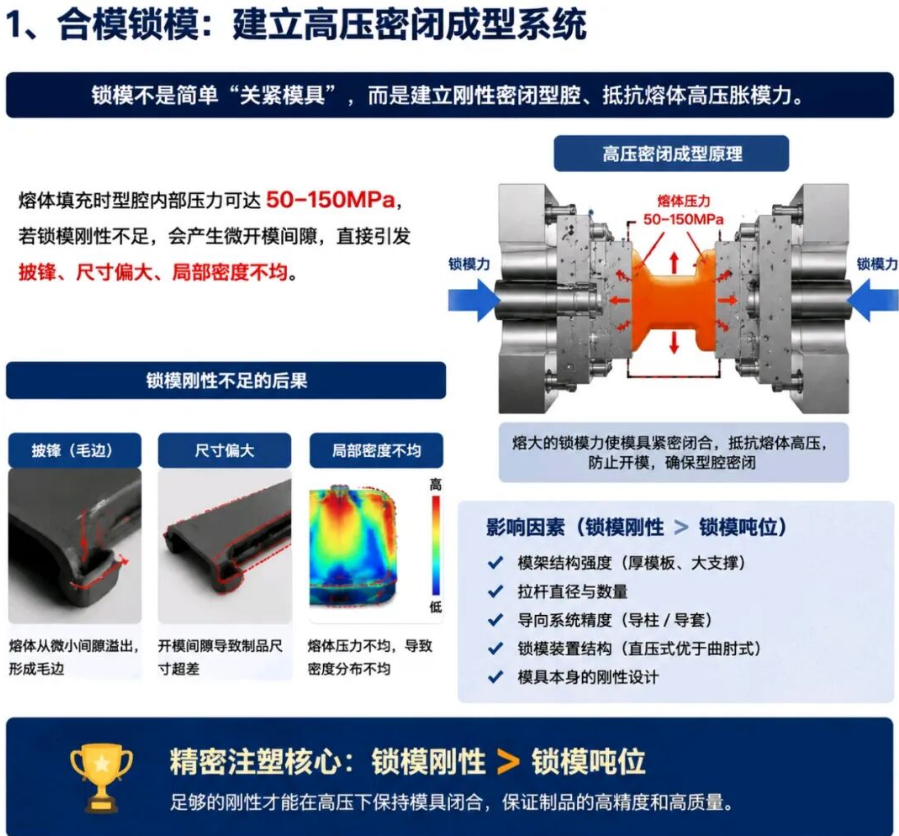
II. Mold Closing & Clamping: Building a High-Pressure Sealed System
Clamping is not simply "closing the mold tightly," but rather establishing a rigid sealed cavity system capable of resisting the 50–150 MPa melt high-pressure mold expansion force. The core of precision injection molding lies in "clamping rigidity" being superior to "clamping tonnage"; if insufficient rigidity creates a micro mold-opening gap, it will lead to melt overflow forming flash (burrs), oversized product dimensions, and uneven internal density. Therefore, it is essential to rely on a reinforced mold base structure, tie bar design, and high-precision guidance system to ensure the mold remains perfectly sealed under high pressure.
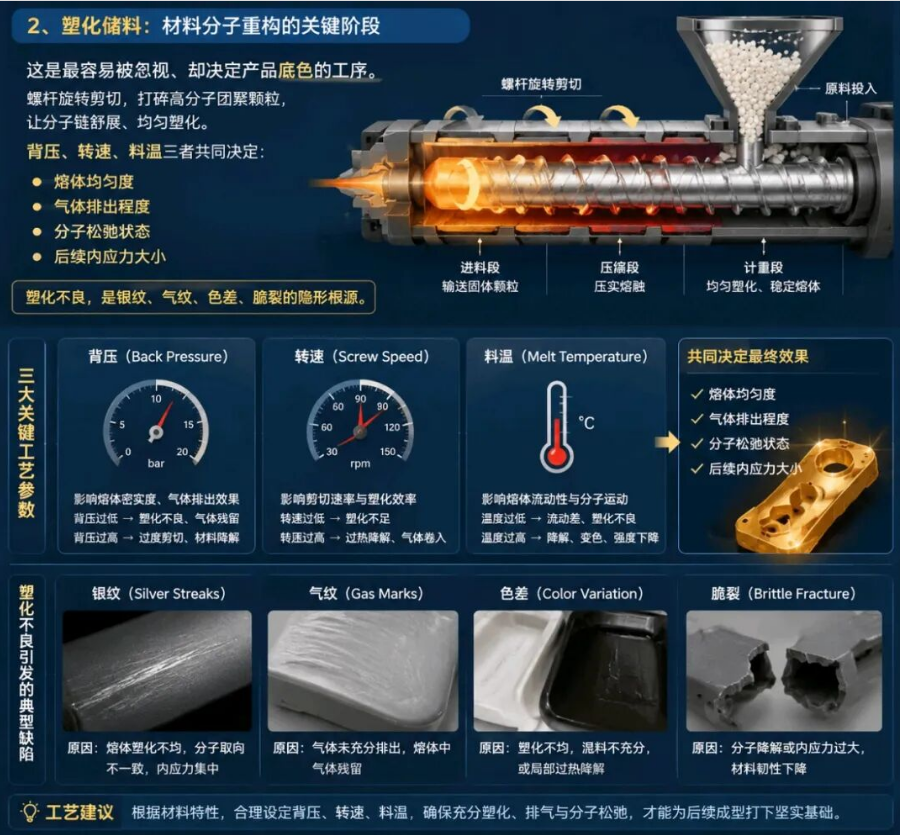
III. Plasticization & Storage: The Critical Stage of Molecular Restructuring
As the key process of material molecular restructuring, plasticization and material storage directly determine the underlying quality of the product. Three core parameters — back pressure, rotation speed, and material temperature — jointly affect melt uniformity, venting effectiveness, and molecular relaxation state. If plasticization is not properly controlled, it can easily cause typical defects such as silver streaks (inconsistent molecular orientation), gas marks (incompletely vented gas), color differences (uneven plasticization/material temperature), and brittle cracking (molecular degradation/excessive internal stress). Reasonable parameter settings are the prerequisite for ensuring subsequent filling and molding quality.
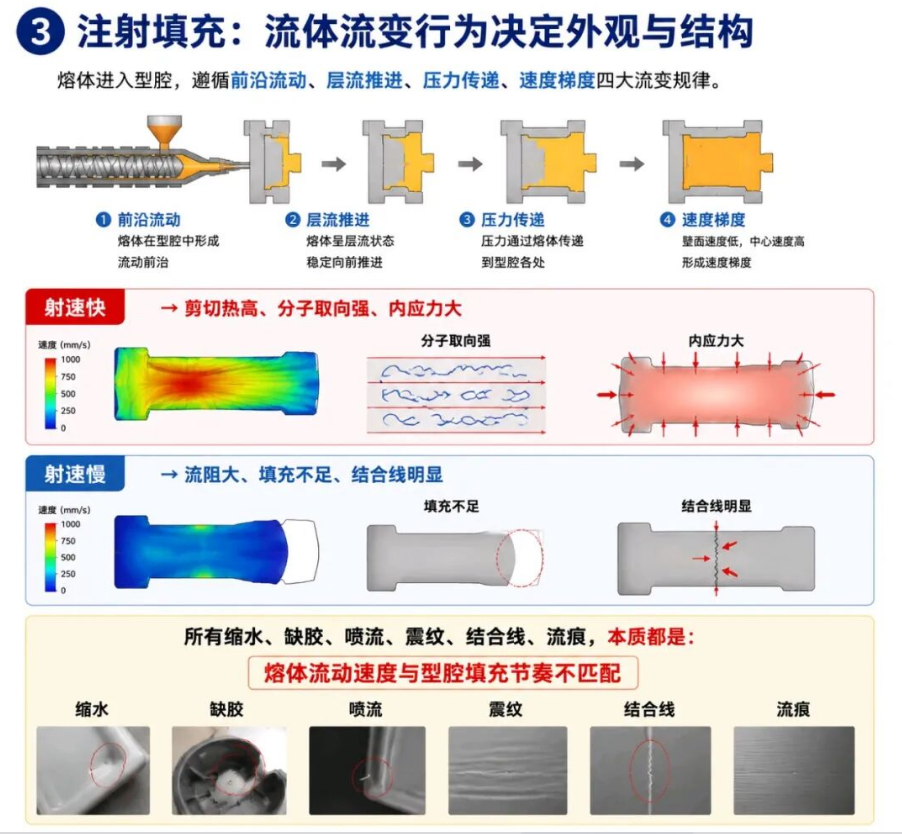
IV. Injection Filling: How Rheological Behavior Shapes Appearance & Structure
When the melt fills the cavity, it follows four rheological laws: fountain flow, laminar flow advancement, pressure transmission, and velocity gradient. Excessively fast injection speed leads to high shear heat, strong molecular orientation, and large internal stress; excessively slow injection speed easily causes high flow resistance, underfilling, and obvious weld lines. All common appearance and structural defects such as sink marks, short shots, jetting, vibration marks, weld lines, and flow marks are essentially caused by a mismatch between melt flow speed and cavity filling rhythm.
V. Holding Pressure & Shrinkage Compensation: The Core of Dimensional Accuracy
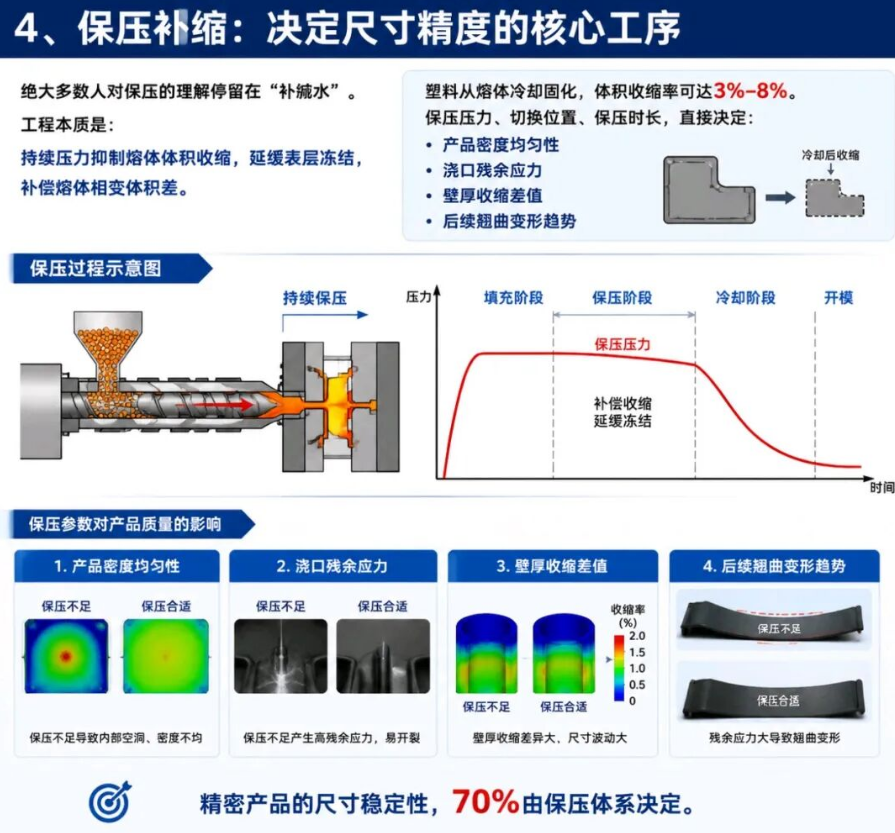
The holding pressure process plays a decisive role in compensating for the 3%–8% cooling shrinkage rate of plastics, and 70% of the dimensional stability of precision products depends on the holding pressure system. Holding pressure, switchover position, and holding time directly affect the uniformity of product density, gate residual stress, wall thickness shrinkage difference, and subsequent warpage deformation trends; appropriate holding pressure can effectively suppress internal voids, reduce residual stress, and minimize dimensional fluctuations, ensuring the product retains its intact form.
VI. Cooling & Setting: The Final Stage Governing Deformation & Residual Stress
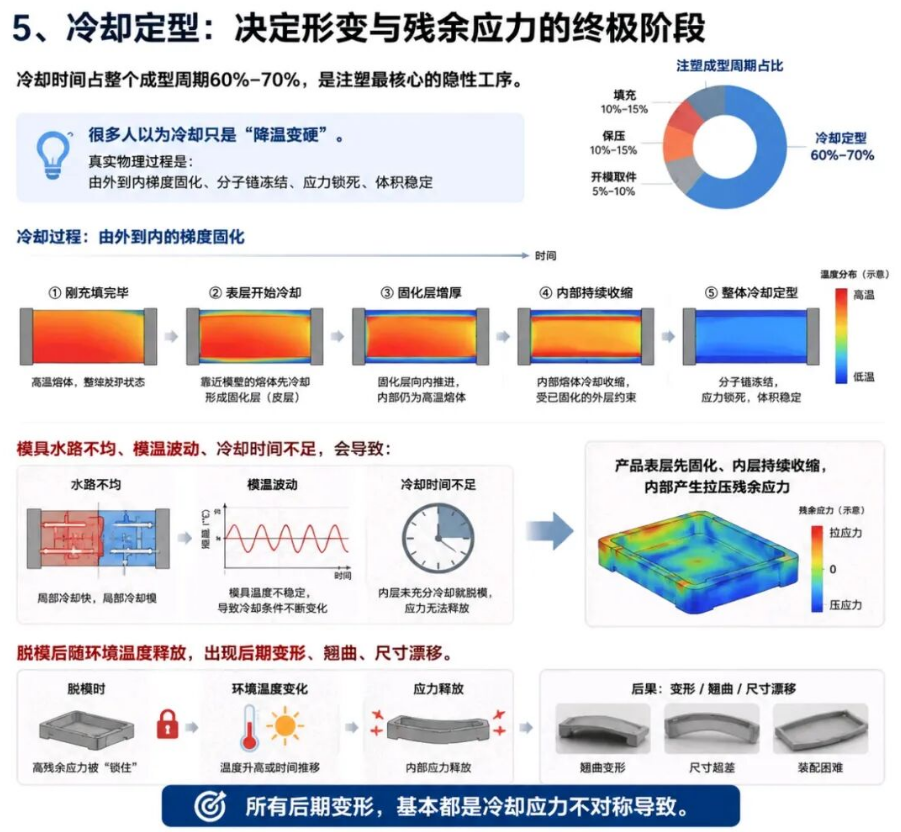
Cooling and setting accounts for 60%–70% of the entire molding cycle, and its physical process is gradient solidification from outside to inside, molecular chain freezing, and stress locking. If uneven water channels, mold temperature fluctuations, or insufficient cooling time occur during the cooling process, complex tensile-compressive residual stresses will be generated internally; these stresses are gradually released after demolding with environmental temperature or time, and are the root cause of post-molding defects such as warpage deformation, dimensional deviation, and assembly difficulty.
VII. Mold Opening & Demolding: The Final Window for Stress Release
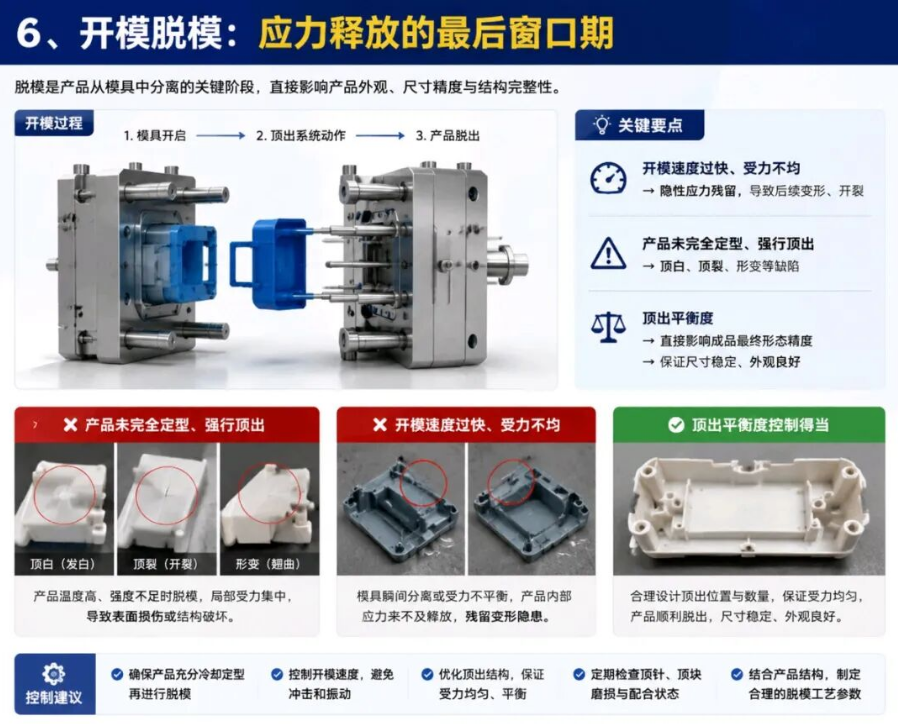
Mold opening and demolding is the critical stage where the product separates from the mold, directly affecting appearance, dimensional accuracy, and structural integrity. If the product is forcibly ejected before it is fully set, or if the mold opening speed is too fast and the force is uneven, it can easily cause surface or structural damage such as ejector marks, ejector cracking, and warpage deformation. Therefore, it is essential to control the mold opening speed, optimize the ejection structure and quantity to ensure balanced force, and demold only after the product has fully cooled and set, in order to guarantee the quality of the final product.
Article Source: Injection Molding Memo
Disclaimer: The content and images contained herein are sourced from public channels such as the Internet and WeChat official accounts. We maintain a neutral stance toward the viewpoints expressed in this article, which is for reference and exchange only. The copyright of republished articles belongs to the original authors and institutions. If there is any infringement, please contact us for removal.

- < Previous : [Tech]Two-Color Injectio
- [Tech]Five Causes of Dim : Next >

- Stock Code
838363

- +86 186 6517 1961
+86 186 6687 8722
-




- Chat
- Top