

Five Causes of Dimensional Instability in Injection Molding

Anyone working in injection molding has surely encountered this frustrating issue: the same injection molding machine, the same mold, the same raw material — yet during production, product dimensions sometimes pass, sometimes run large, and sometimes run small. Most people's first reaction is to shift the blame: aging machine, poor raw material batch, insufficient mold precision. Few look inward at the underlying logic of process control. Applying ordinary plastic part molding logic to high-precision parts will only result in batch defects and delivery delays.
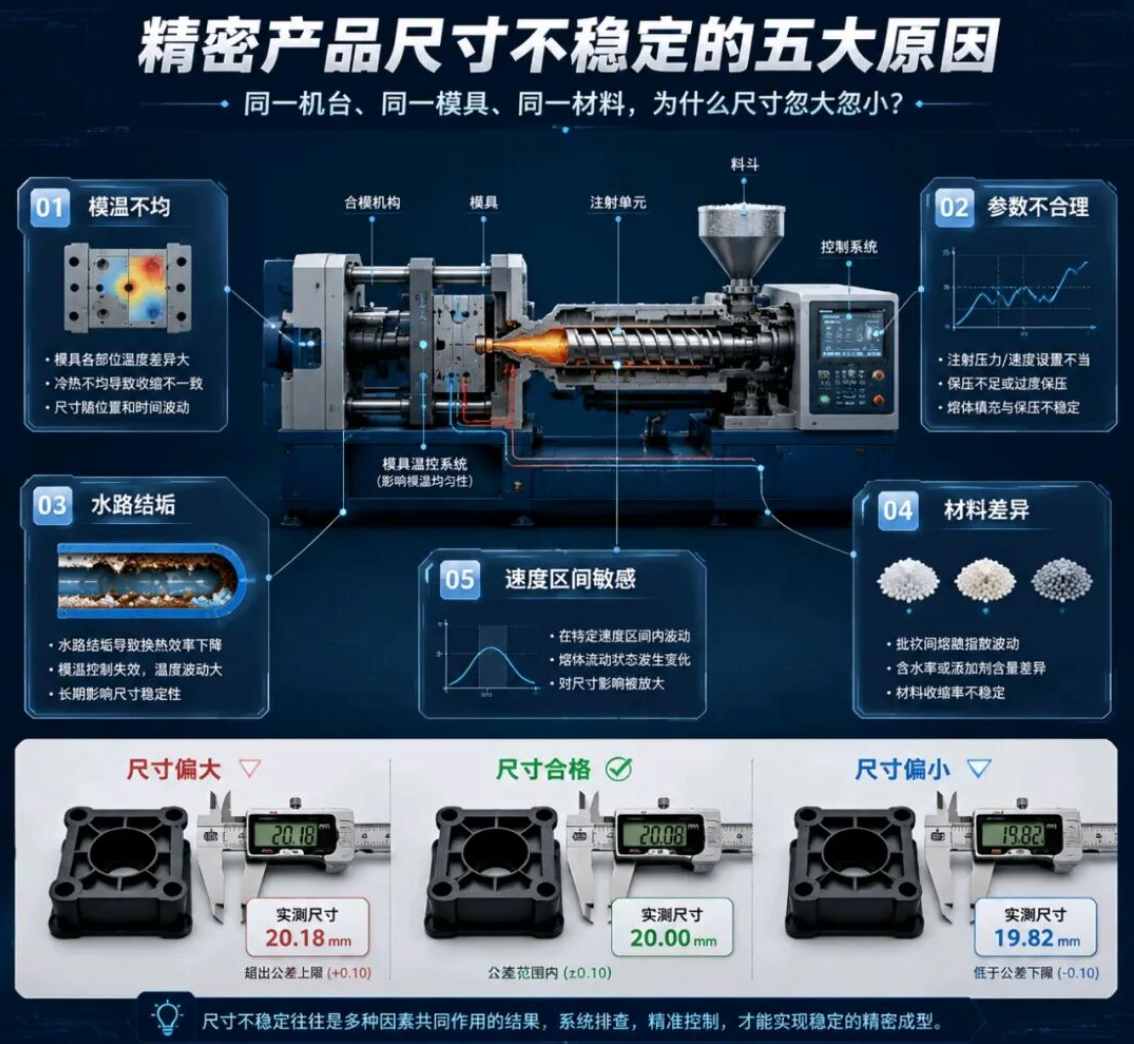
I. Uneven Mold Temperature Distribution
Many factories use a series design for their cooling water channels, where cooling water flows sequentially through cavities 1, 2, and 3. The inlet water temperature is low, while the outlet water temperature at the end rises significantly, creating an inherent temperature difference across all cavities.
As production continues, the water temperature difference keeps widening: qualified production requires cavity temperature differences to be controlled within 3°C, while series water channels often exhibit differences of 5°C, 10°C, or more. With inconsistent plastic cooling shrinkage, dimensions naturally fluctuate up and down.
In addition, unreasonable layout of mold water channel openings and varying distances between water channels and cavities can also exacerbate mold temperature imbalance.
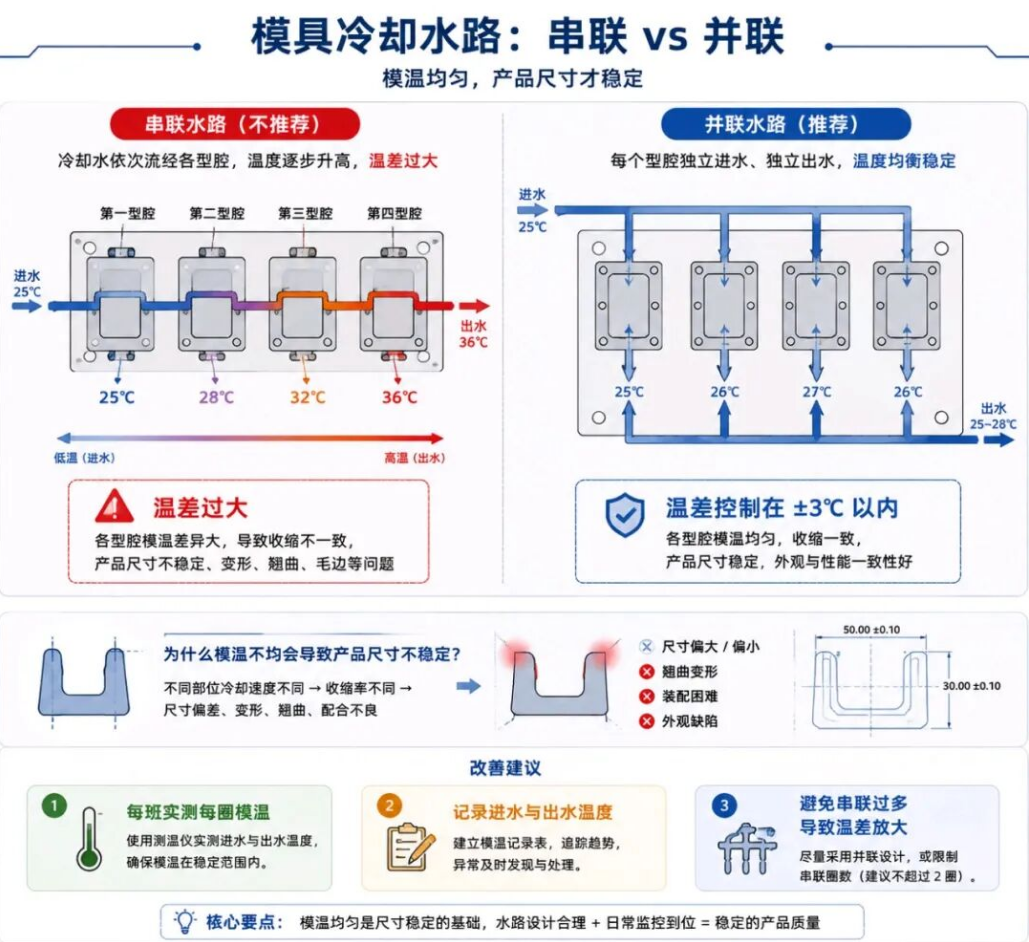
Use a temperature measuring instrument to regularly measure the surface temperature of every water channel and every cavity per shift, keep data records, and strictly control the temperature difference within ±3°C; for multi-cavity molds, switch to parallel water channels whenever possible to eliminate long series cooling layouts.
II. Incorrect Molding Parameter Setting Logic
Experienced machine operators making ordinary housings are accustomed to relying on time-based switchover to holding pressure, which has a high fault tolerance and shows no obvious problems.
However, precision plastic parts are extremely sensitive to pressure and melt filling. Relying solely on time to control holding pressure means the melt fill volume and compression volume fluctuate with each shot, and the accumulated positive/negative dimensional deviation can reach 0.1–0.2 mm.
Many people, upon finding dimensions too small, simply increase holding pressure — which treats the symptom rather than the root cause: the problem is dimensional instability, not simply undersized parts. Blindly adjusting holding pressure will only worsen the fluctuation.
For precision plastic parts, uniformly adopt the scientific injection molding logic of position-based switchover to holding pressure, precisely control the melt filling endpoint, stabilize the internal cavity compression volume, and reduce dimensional fluctuation at the source.
III. Long-Term Neglect of Cooling System Maintenance
The cooling system is an equipment critical point that is极易 overlooked. Cooling towers and mold water channels that go uncleaned for a long time accumulate scale and sludge on the inner pipe walls, drastically reducing the heat exchange capacity of the cooling water.
Under the same cooling time, unstable mold heat dissipation causes the mold temperature to fluctuate up and down, and the plastic shrinkage rate changes continuously — directly leading to batch dimensional deviations. This is a widespread problem commonly found in small and medium-sized injection molding factories.
Establish an equipment maintenance log, and regularly clean cooling towers, filters, and mold water channels; add descaling and filtration devices to the circulating water to ensure constant cooling and heat exchange efficiency.
IV. Raw Material Batch Flowability Differences
The same grade of plastic from different batches, different manufacturers, and different storage periods inherently has variations in melt flow index and melt flowability.
When incoming materials on the shop floor are not tested for melt flow index, old and new materials are mixed arbitrarily, or raw material brands are swapped without adjustment, the melt filling resistance differs from shot to shot, the filling weight becomes unstable, and ultimately product dimensions fluctuate continuously.
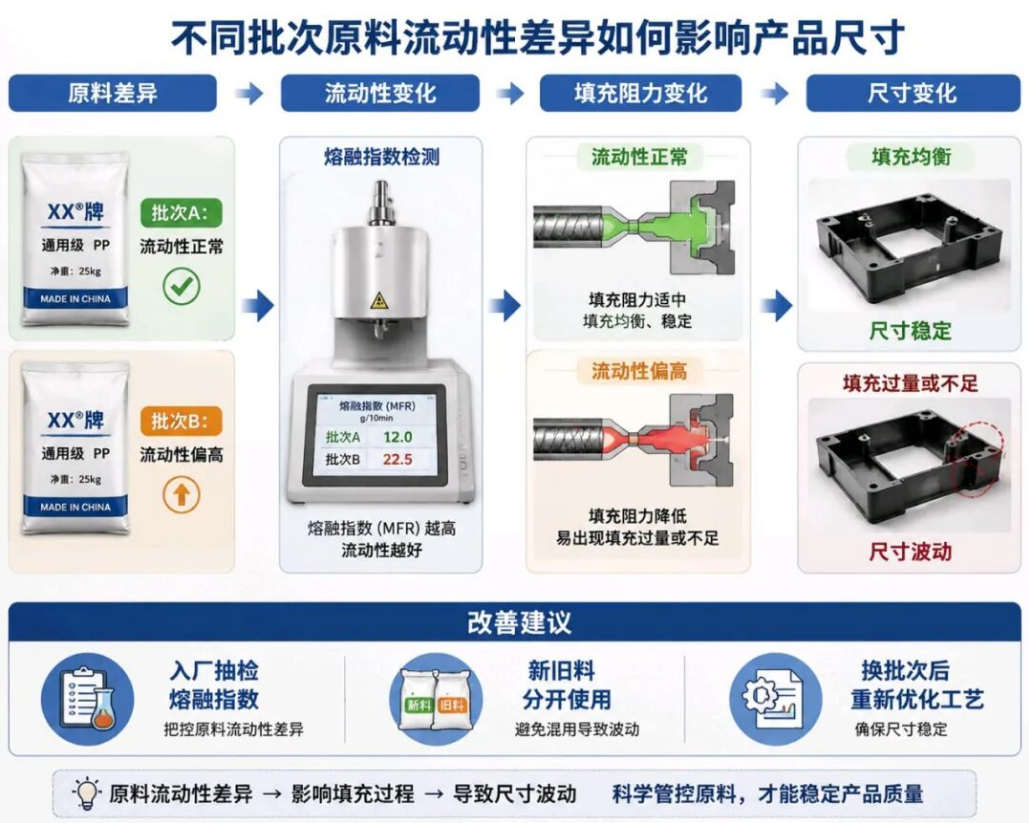
Conduct sampling inspection of melt flow index before raw materials enter the warehouse, and use old and new raw materials separately; after changing materials or switching batches, re-optimize the entire set of molding process parameters — do not continue production with the old parameters directly.
V. Injection Speed Exceeding the Stable Range
This is the core critical point most easily overlooked: every type of plastic and every mold has a stable speed range.
1. If the injection speed falls within the stable range: minor fluctuations in ambient temperature and hydraulic pressure will barely affect product dimensions;
2. If the injection speed is in the material sensitive range: tiny changes in ambient temperature, hydraulic pressure, or slight mold temperature fluctuations will all alter the melt filling state, causing immediate dimensional deviations.
Adjusting speed purely by experience makes it easy to fall into the sensitive range, resulting in product dimensions that are good one moment and bad the next.
Before production, conduct a scientific injection molding viscosity curve test to precisely lock in the injection speed stable range corresponding to the material and mold, and fix the molding speed within the stable range during production to avoid sensitive speed segments.
Investigate each of the above five points one by one, and you will significantly improve the dimensional fluctuation problem.
Article Source: Injection Molding Memo
Disclaimer: The content and images contained herein are sourced from public channels such as the Internet and WeChat official accounts. We maintain a neutral stance toward the viewpoints expressed in this article, which is for reference and exchange only. The copyright of republished articles belongs to the original authors and institutions. If there is any infringement, please contact us for removal.

- < Previous : [Tech]Six Injection Mold
- [Tech]Injection Molding : Next >

- Stock Code
838363

- +86 186 6517 1961
+86 186 6687 8722
-




- Chat
- Top